Friday, April 29, 2005
A letter , To people who are interested in reading
posted by: beitsahourplayer at 12:11 PM

child of a presoner in bethlem SEP.2004

A letter

To people who are interested in reading

This a photo of a chilled in Bethlehem which his father was arrested 2 years ago

And still in the persons of the occupation

When I took this photo, this chilled asked me

"if you publish this photo will it help my dad to be free"

I kept this photo in my archive among hundreds of photos and each one of them has a story

But this photo stayed special …….

Until last night I was working lat and smoking too much as usual then it hit me

Yes I can help that Childs father

Of course I can publish his photo that's how he can be free everyone will be able to sea his face he will be free

It toke me one year to understand a simple quest

Planting seeds of hope
posted by: salam max at 9:31 AM
Lately we’ve been asking for more photos of graffiti on the Wall to send a positive image of resistance and hope on this site.

Well, in this posting Mobius sends a provocative message to religious Jewish readers. Last look there were 50 comments raging in debate over his “Wailing Wall” concept.


The Orthodox Anarchist causes a stir...

There’s nothing like a bit of controversy to get people’s attention. Mobius, the ‘Orthodox Anarchist’, is a practicing Jewish radical living in Israel and is in complete solidarity with Palestinians. He says that he finds “denial of Palestinian history as abhorrent as Holocaust denial”. Check him out, if you haven’t already.

The Orthodox anarchist is a rare being – Rafah Pundits love him big time, and the feeling is mutual it seems: According to one of their bloggers: “He is the best advocate for Israel I have never met.” But I want to add to this support by saying that Mobius is not that rare: he's no lone soldier, so to speak.

Example: This week, a campaigning journalist from Jerusalem spoke at an AIC meeting in Beit Sahur about his work being based on his egalitarian human values. This was in stark contrast to the other Israeli Journalist who effectively said that she was just writing what her Jewish Israeli readers wanted to read about (i.e. 'human interest' stories about those poor settlers who are going to be ‘expelled’ from Gaza).

A friend from Beit Jala expressed how amazed she was that Israeli Jews worked according to their humanitarian values of common ground and egality. And they aren’t just nice words from Neve – I’ve met him (and other Israelis) in Walaja and seen how inspiringly dedicated he is in his work: As are all of the crew at the AIC office in Jerusalem.

The meeting was another successful way of bringing Israelis and Palestinians together on common ground – something that Neve emphasized in his talk about the role of the media here.

A month or so back two Israeli refuzniks from New Profilecame to speak to a packed audience of Palestinians and Internationals, giving an opportunity for Palestinians to meet Israelis who refuse to serve the occupation. Palestinians usually find it heartening and encouraging to discover that there are – and often for the first time to actually meet – such Israelis committed to peace and justice in Palestine/Israel.

So, whilst you can ‘meet’ people like Mobius online at any of his sites (and he is certainly a prolific and eloquent writer), you can also meet courageous and committed Israeli activists and journalists who regularly ‘cross the border’ and work side by side with Palestinians in the West Bank and Gaza Strip.

See any of the articles on Israel Indymedia (when they get their server sorted out, that is) for more examples, as well as Anarchists against the Wall (if you can read Hebrew), Ta’ayush or Windows. There are many more too, even if you can’t find them writing everyday online. (Joseph, of the Judean People's Front!, we’re still waiting for you to get 'blogging' again! ;)

All these people are busy planting the seeds of hope in Israel and Palestine and we look forward to seeing more of them here in the Bethlehem Ghetto.
Thursday, April 28, 2005
You dropped your bullets!
posted by: salam max at 7:54 PM
I was stood outside of the DCO checkpoint coming back from a rally in Walaja. An army jeep drove past us and one of the soldiers dropped a full magazine of M16 bullets out the back of the jeep… and kept driving!

Not one to pick up live ammunition myself, I watched as someone else went to check it out. One of the Palestinian drivers in the queue to get into Bethlehem called out: “Here, give it to me!”

So he came and got the bullets, drove to the front of the queue, called the soldiers and told him what had happened.

“Hey, you’ve dropped your bullets. Can I pass the checkpoint now?!”

The bemused soldier took them from him, and the driver got through. I hope none of those bullets end up in his back.

Everyone here says the same: “We just want peace, but Sharon wants war. He’s crazy!”

When will Israel realize that Palestinians just want to be left in peace?
Wednesday, April 27, 2005


A collection of spray cans were seen bouncing towards the wall several days ago. When they bounced back, they bounced lighter and left the Wall speaking...

This watchtower is the first one that greets you as you enter 'Bethlehemghetto'. Rumour has it the lone spray can is still there...waiting...
Tempted?
posted by: peacerider at 8:56 PM

As the wall climbs so does the graffiti. These bold but true statements were found at the entrance to Bethlehem's ghetto...keep them coming.


Any guesses?
posted by: peacerider at 3:27 PM
The baby speaks
posted by: peacerider at 2:57 PM


A recent visit to the Wall showed some new and ever 'hopeful' graffiti.
One piece of too many
posted by: peacerider at 2:54 PM
Peace and Love?
posted by: peacerider at 2:45 PM
Tuesday, April 26, 2005
Evil times
posted by: snoopy at 5:34 PM

This morning the sun rose over a new part of the ugly wall eating into the Caritas/Rachel's Tomb neighborhood of Bethlehem.

The effect of seeing new parts of the wall is still horrifying, sometimes one seems to have gotten used to the sight, then suddenly one day you turn a corner, and it has eaten new land, poisoned new neighborhoods.

The view is hard to describe as other than ugly and evil. 8 meters of grey concrete cutting through everything. Today the view has it all; armed Israeli security guards, Palestinian workers physically building the monster, barbed wire, Israeli flags, a watch tower, emptied out apartment buildings where the soldiers have taken their posts and covered with army camouflage textiles, and parts of the Gilo settlement in the distance.
This view and this wall symbolize the ugliness and evilness of the whole occupation, from day one.

The Palestinian owners of this land went to court to protest the confiscation, but they did not get any way with it. For any case in court where the justification is "security", the battle is lost even before it started.

Behind lays Rachel's Tomb, where Jewish come to pray in busloads. Apparently this new part of the wall is to encircle a parking lot for Rachel's tomb. When the Palestinian owners of the land heard this they claimed compensation. But of course there is no such thing as compensation for the ongoing theft of Palestinian land.

Across the street from this new wall lays Bethlehem Hotel.
One of the owners is standing across the street from it, gazing at the workers and the crane placing yet another block of concrete on the ground, blocking his view to the olive groves opposite.


The wall admiring its own reflection in a window of Bethlehem Hotel

In the great hopes and optimism of the Bethlehem 2000 project, this hotel was one of many that sprang up in the belief that tourism would only increase in the next few years.

Then the Intifada started and as the Israeli army invaded Bethlehem, the soldiers set up an army post in the Hotel before it even had opened for tourists. As one of several lookouts in the area around Rachel's tomb, this one remained for 4 years. Today the soldiers are no longer posted here, but the hotel is closed, everything inside is broken the owner tells me. The entrance is barred up with bricks, all the windows are broken, and rotten mattresses is all what’s left hanging out of one of the windows.

The hopes for tourists and guests in the future, dwindles for every block of concrete placed on the ground on the other side of the road.

As the peace talks continue amongst high-ranking politicians, new "facts on the ground" are constantly developing amongst the Palestinians on the street.
Monday, April 25, 2005
Journey to Palestine
posted by: refugee at 8:48 PM
September 4, 2002

Journey to Palestine
Canadian Arab Youth Delegation to Palestine

It was the first time, well in history, that an All Arab Youth Group traveled to Palestine, a land and a people that have lived in years of turmoil and strife. We went with an objective in our minds and hearts, our objective was to show solidarity with our brothers and sisters, to tell them we have not and will not ever forget them. Nor will we give up fighting for what is just and a human right for all Palestinian People.

We traveled at a time of serious volatility, we never knew what predicament we would get caught up in but it did not deter us from wanting to take the chance in being with our people. Once we arrived in Bethlehem we headed for Dheisheh Refugee Camp, which was our main homestead while we were in Palestine. It was early in the morning, the air was misty and the streets were empty. We entered the Refugee Camp at a time when curfew had been placed on all of Bethlehem. Not a person was in sight.

We settled in that day and rested for we knew in the days to come we would have very little rest. But I don’t think we were aware as to just how little rest we would have until that night. The Cultural Centre Ibdaa was flowing with people coming in and out into the late hours of the evening. And then it began. The noise of IDF tanks and jeeps rolling onto the main street, we could see them from our bedroom window. There was an operation going on, but we were not sure just yet as to what kind. Then the phone call came from an Ambulance driver, he had told us there would be a house demolition tonight, and to open all the windows, and shut all the lights in Ibdaa. And so we got moving, running anxiously into every room, our hearts trembling while we opened all the windows. And then we waited. All I could think about was that poor family losing all that they have, being forced out of their homes, watching it get demolished and then left with all they could gather in ten minutes time. All of us were so unsure as to when it would happen or how bad of an affect it would have. At 4:30 am, once the Israeli soldiers forced the family to flee their homes with everything they could get their hands on, they filled the home with explosives and in just a few seconds time the families’ home, memories and dreams had been shattered. The three-story home that once stood there had now been rubble, ruins you could no longer tell apart from what already lay on the ground before it. Once it went off Ghalib and I were under the window of Ibdaa, while Jeanna and Danah were upstairs. Rania and Salwa were downstairs in the computer room. The first thing that came to my mind when I heard the thundering crash and the blinding sky light up, was to fall to the ground and yell for Jeanna to get down, hoping she was no where near the windows. From that moment on every door that slammed, every unexpected crash was a horror for us.

In the time that we stayed in Dheisheh we met many, many wonderful people from old to young, who were inspiring and very affectionate. Due to the curfews we had much time to spend with families and the youth, they would tell us their heartfelt stories and about their pain. Everyone had a story, from 18 year old Adham Abu Laban who’s little sister was shot in the head for peeking outside the door of their home during curfew hours, she was trying to warn others of the soldiers presence. To the freedom fighter Ayat Al-Akhras who’s father had been clearing out his families belongings from their home for they had news that their home was on the list of house demolitions ordered by the IDF. Ayat’s father Abu Samir told us how Ayat was an honour student and was about to get married this summer, and how that day when she left and decided to never come back, she left as though it were just another day. I was there when her dad accepted her diploma for graduating high school; it was hard for him to mask his tears this time. Or the story of how Jehad Abbas’s father has been jailed 17 times, and his mother passed on of lung cancer last March when they were under siege. He explained how he had to disguise himself as a Reuter’s journalist to get his mom to the hospital. He is 21, and is the oldest of the 6 kids, and one of them Hamoudy who is Autistic. And never mind the hundreds of stories of people’s homes getting broken into from IDF soldiers, or homes getting riddled with live ammunition, or the thousands of people who are out of work and living on bread and tea morning, noon, and night. Never mind the collective punishment we saw or people would tell us about: waiting hours at checkpoints, getting beaten up, spat on, getting stripped and laughed at and sometimes even shot in cold blood. It was just too much for us to deal with in one day, God to think they have to deal with that every day of their existence….

We traveled to many places in our homeland when we were permitted thanks to the Israeli’s kindness and generosity of course. After the first two days in Bethlehem, we drove to Gaza Strip and stayed there for two nights. Gaza Strip was a nightmare of its own, this small strip of land fenced with electrical barbwire, completely closed off from the rest of the world. It was so meek and desolate as we entered the infamous Erez checkpoint and continued on to meet our tour guide. As we drove further into Gaza you could see the swarms of people and children in the streets, aimlessly wandering trying to free their minds of the endless frustration and constant reminder of the card they have been dealt, the card called Occupation. With over 1.4 million people living in a land of 360 km we were surprised to see people able to move and go about, it was a wonder they did not live on top of one another. Although in the camps like Jabalyia and Rafah, where more then 60-80,000 people lived in just one sq. km., this thought was not far from reality. As we walked into the camps, I felt somewhat ashamed to be there. Ashamed for feeling like an outsider. All eyes turned our way, mostly the children were all so curious about us and what it is we were doing there, most were pleasant and welcoming. Although one woman did snarl and say, “look, take pictures of our misery, go head”. When she had did that I felt like I wanted to run into a cage and hide, for even though I knew my intentions were good, what she stated was exactly what we were doing, taking pictures of their misery, of their hardships and tragedies. Our tour guide intervened and told the women that we were Palestinian and we were there to help, but it somehow didn’t make me feel any better about what had just happened. I will never forget her.

There’s nothing that could describe the emotions that erupt within you when you see the inhumane acts that are committed against the people of Palestine, atrocities that have been ignored by the world. I truly felt as though an insect had more rights then I.
I felt for the first time in my life how it is to not have water to bathe in, to wait 3 hours for a soldier with a foreign accent and an M16 to allow me to make my journey from Ramallah to Bethlehem which typically is only a 20 minute ride, to be scrutinized and my belongings taken when entering a mosque for prayers. I never had to experience living like a prisoner within my own home, imprisoned like a caged animal with barbwire and tall fences surrounding me, and having a curfew, something my own parents have never afflicted on me.

How much more proof do we need to see that these people are suffering, how much more collective punishment, how many more demolished homes, how many more mothers will cry for the loss of their children, how many more unnecessary checkpoints, how many more suicide bombings, will have to occur, before we understand how REAL this occupation is.

There was recently an opinion poll in the State of Israel, where 60% of the population supports mass deportation (transfer) of the Palestinians. Even the Nazis never openly declared their intention to massacre the Jews and Gypsies; they as well spoke of deportation and transfer as of their Final Solution. Even in 1938, these ideas have not had such wholehearted support in Nazi Germany, as they have now in the Jewish State. And unfortunately we find history is now repeating itself, except those who were once victimized are now the perpetrators.

We have waited 54 years and then some for international intervention, while East Timor waited a few days before they were rescued from the tragedies of war.

For the Palestinians, life is a pendulum, swinging between hope and despair: the hope in God’s justice and human goodness, and the despair of the reality of our terrible moment in history. Their land has been occupied, their lives are within the grasp of Israeli snipers, and their future is constantly being crushed by an iron fist. And their complaints to the world fall on deaf ears, and when they react to the unbearable living circumstances, they’re rejected, condemned and dehumanized as “violent terrorists”.

But there is one thing I will never forget. We, Palestinians might lose a hundred battles, but as long as we maintain the morality of our struggle we are the genuine winners of this war. The Israeli occupiers might assassinate thousands of our people, and imprison the rest in the hope that we will give up our “Palestinian-ness”, but their strategies will never prevail, and more importantly they will reinforce our determination to survive.


Linda Sweiss
Team Leader
Canadian Arab Youth Solidarity Delegation
Palestine August 2002
Photo of the thief
posted by: beitsahourplayer at 10:38 AM

The Patriarch Irineos the thief
Photo by : beitsahourplayer 7/01/2005

What is not said yet? Its time to do action
He is a thief and everybody know that by now .
we do not want this thief
Its time to do action of freeing our churches from the hands of the thieves
to know the story here is an article from aljazera :

Earlier this month, the Israeli newspaper Maariv reported that foreign Jewish
investors had paid millions of dollars for two large properties for hotels to be
built at the Jaffa Gate on the walls of the Old City of occupied east Jerusalem
in a secret deal with the Greek Orthodox Church. East Jerusalem is seen by
the Palestinians as their future state capital.


the Christians need to be free from this occupation which is the Greek occupation of Palestinian churches
Sunday, April 24, 2005
From the Balata Camp Ghetto
posted by: salam max at 7:44 PM


I went to visit Balata refugee camp on the edge of Nablus recently. It's poor, run down and crowded. The alley ways are so thin you wonder how the soldiers get round them with their explosives to blow up the houses there, as they often do. Bullet holes are everywhere and posters of Shaheed (martyrs) are plenty.

The night before there was another invasion, and they told me that every night it is the same: No ceasefire here. Assassinations and arrests continue as before, though there are less daily invasions and shootings during the day that characterized Nablus, and Balata camp in particular, throughout the intifada.

I met with some volunteers from the Balata Film Collective, who showed me some of their films and explained the projects they have going on in a camp badly in need of some creative outlets for the 20,000 plus refugees living there.

They too have opened up a means for Palestinians in the Balata Ghetto to express themselves to the world, through their website and their films. As they put it themselves:
Film is an important means of both resistance and communication. The Balata Film Collective was initiated to enable young Palestinians from Balata to break their isolation, challenge their oppression and represent their lives to the world.

The Balata film production collective films, edits and produces movies in Arabic and English. Films produced will include shorts uploaded to the internet and full-length movies distributed on DVD and VHS. Interesting footage will be made available on a server for other filmmakers across the world.
Check them out: They have a young team of journalists making films and writing articles, and they also have a women's centre with an internet cafe. This is one project we look forward to seeing more of.

Let us know of similar projects to Balata Camp Net and similar sites to Bethlehem Bloggers. It's important for us to stay in touch with each other, and support each others work.
Saturday, April 23, 2005
"3 Checkpoints and around 26 Soldiers"
posted by: peacerider at 7:08 PM

He hits the wing mirror causing it to buckle inwards. He tears the permit from the drivers hand, scrunches it up and throws it on the floor. The green plastic wallet retaliates and resumes its original shape before landing on the tarmac. He shouts in Hebrew to unresponsive ears. He motions to the queue of taxis and cars behind us and then kicks the driver's door. The other solider leans into the passenger's window. He continues the shouting. They hit the taxi again as we drive on. The one way conversation went something like this:

" Can I please see your id?"
(The permit is handed out of the window)
"What are you doing to us? You are causing a big mess"
"Go back round!"

We were traveling from Qalandia checkpoint back to Beit Sahour. A journey of 2 hours and 40 minutes, about 25km or alternatively as measured by another passenger of "3 check points and around 26 soldiers". We have approached a flying checkpoint; a temporary checkpoint used by soldiers to harass Palestinians. I use this tone because only cars with Palestinians license plates are stopped. And often permits are collected and returned later with no 'checks' ever ran through.

At this particular flying check point, our taxi driver had pushed in front of the other cars. This was his punishment; returning to the back of the line. Unlike the soldiers, our driver remained calm. He said no words. Although he spoke little Hebrew he didn’t even try to resist or to defend himself and his taxi or their permit. He drove on a little and then turned the taxi around, drove back, turned around and joined the back of the ever increasing queue.

Now we are sitting here waiting. Two babies, two mothers and a small child. One Hebrew speaker and one suspicious father who has been repeatedly asked for his id since we left Qalandia checkpoint more than one hour ago - or rather less than 10km ago. We are waiting and watching as the Israeli license plates drive by; flowing through the right hand side lane. The yellow taxis with their Palestinian plates are piling up in front of and behind us. The line moves forward a little and there is a rush as those who have climbed out of their respective cars for some relief from the stifling 'waiting' air quickly climb back in. More engines start. The queue stops again. We wait. No one says a word. The taxi driver leans out of the window and pushes the wing mirror back out to its original position. We wait some more.

As time passes we approach the front of the queue. Another taxi driver dodges between the waiting cars. He is holding a selection of discarded permits, waving them in the air, for his colleagues and cohorts to reclaim. He quickly returns the permits to their 'owners'. It seems we weren't the only ones who were 'punished' for moving too quickly towards the flying checkpoint. Our driver signals to him and his reclaims the piece of stubborn plastic. We are waved through. Past the soldiers and their boots which like to kick car doors.

One baby starts to scream. The other baby is silent. The other baby screams louder. The other baby remains silent.

Posted by Peacerider
Tuesday, April 19, 2005
don't read this unless you are.............
posted by: refugee at 6:41 PM
From the sons and daughters of Dheisheh refugee camp to all the people of the world.

We the residents of Dheisheh would like to tell you a little about our lives under this cruel Israeli occupation.

We have lived since the moment of our birth, the life of disposition, the life of a refugee on his own land. Since our childhood - but nothing that resembles childhood- we realized the ugly meaning of occupation, the meaning of being a refugee, the meaning of dispossession and loss.

We understood the meaning of slavery, and we are willing to die to get it back our freedom. We understood the meaning of having and lost, and we now think of nothing else but how to return what is rightfully ours. We only talk about how we can live like other people, in freedom and dignity.

And this is not impossible.

We hear of something called animal rights… when I see a dog being walked by his owner, I wish I was that dog, because this dog’s life is better than what I have to live through.

We grew up in a refugee camp, under occupation, me and there rest of my generation were born before the first intifada of ’87, in that time – even though we were children- we understood what it meant to participate in the intifada, with everything we could we participated, but there was nothing but stones… And we used them…

We continued our resistance with stones for seven years, and when the so-called ‘peace’ was announced, we thought maybe we would see a glimpse of that peace. But with every passing day, we realize that this so called peace is just another form of occupation, occupation through negotiations. Everyone can see the undeniable evidence of this cruel peace; the fact that more Jews have come to Palestine, and the increase in settlements since the Oslo agreements. This lie that was perpetuated resulted in the peoples disillusionment, resulted in increasing the pressure on the people, rejecting the idea of ‘peace’, until the moment Sharon walked into Al Aqsa, it was the spark that forced the people to announce their anger. And the people became convinced that freedom will never come without resistance, this was the birth of the new intifada.

This new intifada saw more than just stones, now we owned light weapons, but even these weapons are nothing compared to the Israeli arsenal. But we have something stronger than all their weapons; we have the will to fight for our freedom. Despite all the martyrs, the injured, deported, and imprisoned, we are still willing to fight, because we are fighting for our freedom. If freedom is not ours it will be for our children, or our grandchildren. As we always say, a child’s smile is stronger than an Israeli warplane.

This is our message:

To all who claim they are human beings
To all people
Regardless of their color, religion, or race
To America
which knows of animals rights, But knows nothing of other nations dignity independance
To the west, east, north, and the south
To all who lead a nation or people
To everyone who has a conscience you must wake up !
There are a people called Palestinians
There is a land occupied and raped
This is Palestine
Innocent of all other names
A people surrounded by all means of oppression
There are children that die everyday of hunger
There are refugee camps
With residents holding UNRWA cards
There are American/Israeli warplanes
Assassinating the old and murdering the young
There are Israeli soldiers
All this in the face of a defenseless people
But who wants life, will live despite them
We will not kneel, and will not surrender
Who wants freedom will die for it

From the children of Palestine, from the children of the birthplace of Christ, from the children of Dhiesheh refugee camp, these are our words despite all the weapons, and the barbed wire, despite the fact that we do not even own our own livelihood; because of the rape of Jerusalem we must fight, and we must win. Good must win over evil. We must taste the freedom we have been deprived of all our lives. We must tier up one day those UNRWA cards, and we must return to our original towns and villages. One day we must see a flag with the bright Palestinian colors fly high above the mosques and churches of this holy land, in spite of America and Israel, and in spite of those who dare to call us terrorists.

We are peace loving, and we are dieing for it. We are the ones who created it, and they are the ones that kill who dreams or thinks of it. They are the ones who killed Rabin, and want to kill Arafat. They are the ones who killed Mohammed al Durra, Eman Hijo, and Faris Oda. You must understand, when these children were killed, they killed with them any prospect of peace.


To Arial Sharon who disillusions the Israeli people with his grand plans, your defence shield was destroyed by our stone throwing children, and the Palestinian resisters. To you who claim you are a man of peace, to you from the children of Palestine, we say: give us our land and freedom, and we will give you your security.

This is the only solution for my people and your ilk.


From the refugee camps of Palestine to the world, despite of the distance, despite of the curfew, despite the days we lived in tents, I send you this message: I am a refugee, and I will not offer an olive branch, because I know that in Oslo we were not even mentioned.
Breaking stuff... because!
posted by: username at 4:41 PM
I went out today to the villages of Al Khas and No'man, east of Bethlehem, to show someone an olive tree field that was planted along the path of the wall, adjacent to the fencing and dirt road Israel carved out of the countryside in preparation for the completion of the wall. We were showing a visiting partner two fields we planted in March, when internationals and Palestinians joined together to plant olive trees where the farmer's land was under threat. On that day, school children from Beit Sahour had taken the day off from school to come out and help us plant, and internationals turned out in high numbers to support these villages where more than 120 trees have been uprooted by Israeli forces.

We came to these fields today because we heard the soldiers had visited them just two days ago. After getting ourselves lost in the weaving streets, running across a lone Israeli jeep that was roaming around in the village, we came out on a hill overlooking the largest of the two fields we planted that day. I almost didn't recognize the field, as the growth around the trees has sprung up to my waist in the month and half since we were last here. We climbed down and wove our way through the thick greenery, lush from the rainy season, where we found the remains of the plaques.

When the field was planted, two plaques were placed on the field in gratitude to the donors who covered the cost of the trees and irrigation systems. This is standard practice for the fields we plant and there are fields all over the West Bank with plaques displaying thousands of donor names. This field, though, was special. Twenty-three of these trees were planted in honor of Rachel Corrie, the ISM activist killed in Gaza who should be well known to everyone reading this blog. A plaque was prepared in Arabic, Hebrew and English to honor Rachel's sacrifice in Gaza. It read: "Rachel's Grove. In memory of Rachel Corrie. Defender of Peace and Justice."

We found the plaques today, Rachel's and one other, smashed into several pieces against the rocks used to prop them up in the field. A local Palestinian informed us that two days ago soldiers stopped on the road above the field and stood looking down at it before two of them climbed down, broke the plaques and left. I can only imagine boredom and indifference led them to such a small act of vandalism.

Soldiers broke Rachel's plaque against the stones


While major human and civil rights abuses plague Israel's occupation, and political maneuvering by Israel is constantly destablizing peaceful initiatives, the often ignored absurdity of occupation as a means of pacification is a perpetual current running against peace. Twenty-year-olds, given guns, time, power, open mandates, a lot of boredom, and a society without respect for the population it occupies, are always going to fall into harassment of the people they control. This harassment, experienced daily by Palestinians for years on end, ranges from simple vandalism like I saw today to the disruption of family life and access to work.

And this daily control and manipulation is excercised at the whim of those two soldiers who were bored enough to climb down the hill, pick up the plaques and throw them against the rocks.
From Rafah to Bethlehem
posted by: shihad at 10:26 AM

On the International Day of Action Against Caterpillar (April 13), a CAT D9 Armored Bulldozer works alongside an Israeli Merkava tank and other heavy equipment on the route of the Wall in Rafah.

There are some things that make you yearn for the friendly confines of the Bethlehem ghetto. As Israel surrounds Bethlehem with a Wall (a Wall of Segregation, a Wall of Apartheid, a Wall of Annexation) Israel's bulldozers and cranes are also active in other areas. This week I was in Rafah in the Gaza Strip. Rafah is like another world - a horrifying, sad and dangerous world. Less than 300 meters from my friend's home in the Yebna Refugee Camp, an Israeli tank guarded a bulldozer, crane and other heavy equipment erecting additional sections of Wall between Palestinian Rafah and Egyptian Rafah.

The Wall in Rafah is constructed on Palestinian land that was once covered by the homes of Palestinian refugees. The land is now a sinister wasteland, patrolled by Israeli Merkava Tanks and Caterpillar D9 Armored Bulldozers. Sniper towers loom over the Wall, dominating the area and shooting anyone who approaches. On April 9, three Palestinian children were shot and killed when they ventured too far into this "buffer zone."

According to the Rafah Municipality, Israel has demolished approximately 4,000 Palestinian homes in Rafah since October 2000. An additional 1,500 homes have been partially demolished and more than 10,000 damaged. Around 7,000 individual Palestinian families in Rafah have lost their homes and 5,000 more families have been forced to leave their houses. The rest of Rafah wait nightly for their homes to follow suit.


Demolished homes and shops in the Al Brazil neighborhood of Rafah Refugee Camp. These ruins remain from a large-scale Israeli incursion in May of 2004 - one of many invasions of Rafah last year.

Residents of Rafah have lost approximatly $24 million worth of agricultural land to Israeli bulldozers and the municipality estimates damage of up to $16 million to roads and public infrastructure as a result of repeated Israeli invasions. There is little work in Rafah and 80% of the population is unemployed. Every man, woman and child is traumatized. It is painful to see anywhere, but especially in the children who struggle to sit still, their eyes darting from side to side, frantically waiting for the "jaysh" (Israeli soldiers) to come.

Over the past two years I have had the honor of spending several nights with friends in Rafah. There is never a night in Rafah that the town does not face a barrage of heavy caliber gunfire from Israeli tanks and sniper positions. The army sets nightly explosions underground and in homes in the buffer zone- systematically clearing more land and terrorizing the town.

Returning to Bethlehem, I walked through the checkpoint and entered the ghetto through the narrow gap in the Wall that now severs the once bustling road between Bethlehem and Jerusalem. The Wall in Bethlehem is choking the city, killing the economy and imprisoning the people in a ghetto - but it could be worse.
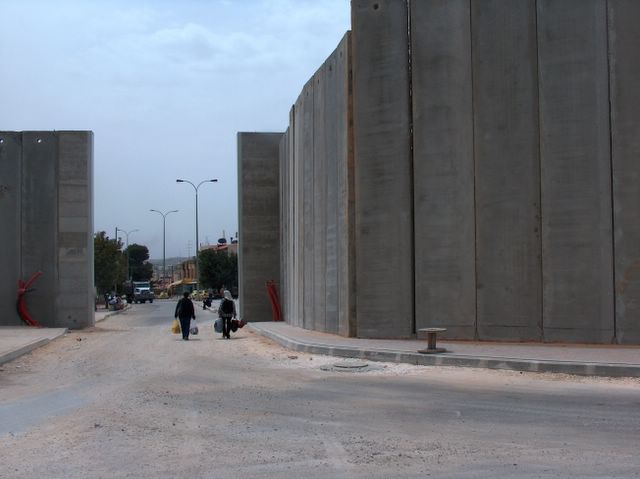

The northern entrance to the Bethlehem ghetto. . . home sweet home.

For more information and updates from Rafah see Rafah Pundits and Rafah Today.

For more information on Caterpillar Bulldozer sales to Israel see the Electronic Intifada CAT Focus and the CAT Campaign website by A Jewish Voice for Peace.

Torture
posted by: salam max at 9:55 AM


I hadn't realised that 17th April was a day set aside to remember Palestinian political prisoners until after I wrote a short, angry piece about my friend who was arrested that weekend. Then Helen gave us some more details another Israeli mini-invasion of Bethlehem (see post below), and today I see this press release from the Mandela institute:
On April 17th every year, Palestinians stand unified in solidarity with Arab and Palestinian political prisoners held in Israeli custody. Thousands of Palestinians have been imprisoned as a result of their struggle for their inalienable and legitimate right to self determination and the right to an independent state with Jerusalem as its capital. [...]

The Mandela Institute vows to stand beside the Arab and Palestinian prisoners held by Israeli occupation authorities. The Institute pledges to continue the fight for the just cause of political detainees and prisoners to ensure them the minimum standards that guarantee them a dignified life pending their release
Those others who were arrested on Friday night are still being held. For sure they're being "interrogated" and for all I know they're using "reasonable physical force" (i.e. tortured). The Adameer website, another body devoted to the release of political prisoners, say this about the use of torture in Israeli prisons:

The Use of Torture during Interrogation and Detention
The ruling of the Israeli High Court of Justice on 6 September 1999, following a petition by human rights organizations to ban the use of torture during interrogation, does not forbid the use of torture but rather allows that interrogation methods deemed as torture may be used in the "necessity of defense" and in situations where a detainee is deemed a 'ticking bomb'. At most, it offers the victim of torture a small opportunity to submit a complaint if an abuse can be clearly proved. As Israel can legally hold detainees incommunicado for several weeks, GSS interrogators are able to use methods of torture without impunity. Legalized torture includes, for example, sleep deprivation and shackling for extended periods of time, amongst others.

A Palestinian detainee can be interrogated for a total period of 180 days, during which he/she can also be denied lawyer visits for a period of 60 days. After the 180 day period, charges must be brought against the detainee, or he/she must be released. During the interrogation period, a detainee is often subjected to some form of torture ranging in extremity, whether physical or psychological. In some instances, detainees have died while in custody as a result of torture. Confessions extracted through torture are admissible in court.

In practice, Palestinian detainees are submitted to the following forms of torture:

  • Routine: sleep deprivation, shabeh (position abuse), in which detainees are shackled to a chair in painful positions, squeezing of handcuffs, beatings, slaps, kicks, physical and psychological threats and humiliation;

  • Special methods: the body tied in a contorted and extremely painful position, pressure on different parts of the body, strongly shaking the detainee after being shackled for a long period of time, head covered with a filthy, soiled sack, strangulation and other means of suffocation, pulling of hair, multiple humiliations;

  • Inside the cells: sleep deprivation, handcuffed to the bed, exposure to extreme temperatures, prolonged and continuous exposure to artificial light, solitary confinement, tear gas inside the cells, inhuman detention conditions.

GSS agents can act with full impunity. If a complaint is lodged, investigations are confidential and led by a GSS agent under the authority of the State Attorney. No agent has been charged since the responsibility for investigations was transferred to the Ministry of Justice in 1994.

Other bodies like the IDF, Border Police, Police and others also use torture and inflict ill treatment upon detainees during arrest, interrogation or detention.

Monday, April 18, 2005
The Israeli violations continue in Bethlehem district
posted by: Helen Ghawali at 2:26 PM
During the past years, particularly since the beginning of the second Intifada, Bethlehem district has been facing intensive Israeli measures such as land confiscation, house demolition and uprooting of trees.

Today the Israeli settlers of Daniel uprooted at least 200 Olive and Vine trees in Al Khader village west of Bethlehem city which belong to Musa and Omar Salah, it is worth mentioning that thousands of fruitful trees were uprooted in the district for the construction of the Wall and for the settlement expansions.

Moreover, the Israeli Forces incured into Al 'Aza refugee camp in Bethlehem city under heavy barrage of gunfire, searched tens of houses and arrested three Palestinian men (Layth Issa Yunis Al 'Aza, Nawaf Isma'il Al Qaysi and Muhanad Othman Al 'Aza).
Sunday, April 17, 2005
Wanted
posted by: salam max at 1:17 PM

A friend of mine got arrested on Friday night. He was wanted, apparently.

Well, I wanted him to come to a party on Saturday. I wanted to get around to scanning some of his artwork to post up on this site. I wanted to hear more stories from him and his friends about their adventures in Ramallah. All of us here wanted to see him do well at University and go on to a better life after being stuck in a miserable refugee camp in Bethlehem.

But the Israeli army wanted him in prison. And what they want, not us, is what really counts over here. I don't know when I'll see him again, only the State of Israel know that.

Photo from a Freedom for Prisoners protest in Bethlehem, one face among many, by peacerider.
Saturday, April 16, 2005
Christian Pilgrims
posted by: Frubious Bandersnatch at 11:06 AM
Bethlehem is a tourist city - or rather it used to be. This is no surprise as the three main classical theist religions all find significance here. These days however visitor figures struggle between the 5-10% mark of what they used to be.

Traditionally many of the visitors are Christian pilgrims who feel the need to visit the city which is at the core of their religion. The 5-10% that still come to the area must enter through the huge concrete gates which indicate the border of the Bethlehem Ghetto. How can it be therefore that many of the pilgrims who come here have either little of no knowledge at all about the situation in this city?

Now, Im not a Christian man - yet this is not to say that I am atheist. I understand the need of these people to undertake holy pilgrimages and feel closer to their idea of God. Also, Bethlehem as a city badly needs visitors to support its choking economy. So on both of these counts, the tourists are very welcome. What I don't understand about these pilgrims is that my concept of a pilgrimage would include meeting, understanding and empathising with the local population of the place I choose as my pilgrimage site. Surely if you believe you are visiting Gods city then you would feel a desire to mix with Gods people?!

I encountered one of these groups this morning outside my office. They were just one of many groups which I have met that all have one thing in common. They had no idea about Bethlehem Christianity or the suffering of the people here. One group had even requested an armed guard to keep the local 'problems' away from them during their visit. I have lived here in this 'problem' city for over six months and the only time I feel intimidated is when I have to cross an Israeli military Check point.

One of the most common misconceptions about Palestine is that it is a Muslim country. The majority of the population are Muslim but they live side by side with the Christians here. If only the visiting Christians from the West could see how badly Israel desires to conceal this population and why. I personally do not know which of the two religions many of my friends and acquaintances here are - it makes little difference. But propaganda in the West has created the image of the 'scary Muslim Palestinian terrorist' and the 60'000 Christians obstruct this myth. Some analysts even explain the ghettoisation of the city as a deliberate attempt to eliminate this 'obstruction' by encouraging the mass exodus of the Christians.

Why am I writing this? For two reasons really. Firstly I want to say to all Christians out there, you are very welcome to come to Bethlehem and I assure you that you will be safe. Secondly, to all those who do wish to come, for Spiritual or other reasons, embark on your journey with your eyes open. Talk to the people, absorb the atmosphere, see the suffering that the Israeli state policies cause on an almost daily basis.

Friday, April 15, 2005
Remembering Tom Hurndall
posted by: salam max at 1:57 PM

The highly recommended Rafapundits - always an inspiration for this site - mourned the loss of Tom Hurndall on Monday, the second anniversary of his fatal shooting in Rafah.

We had a comedy gig in the area on that night, and someone from the ISM (someone who had herself been shot by the Israeli army in Bethlehem) here spoke about the loss of Tom.

How can you remember the killing of an innocent and at the same time introduce a comedy night - appropriately called This is not a subject for comedy? A tough job, I thought, but her words were to the effect that if Tom were still with us on that day, he would have been at a comedy gig too; having a laugh in this country is a fundamental thing to do if you want to keep your sanity, to stay human.

Ivor then had us all in stitches with his dark humour and serious but light-hearted show, as an everyday Jewish bloke from London (his family in North London are refugees... from South London). Palestinians and Internationals in Bethlehem remembered Tom with tears of laughter that night.

Bethlehem bloggers continue in Tom's footsteps; we honour him and his effort to bring the message from Palestine out to the world, as we strive to do with this website.

More info and photo's on the Tom Hurndall site.

A photo by Tom Hurndall in Rafah, April 2003. More of Tom's photo's on the Hurndall Website.
Thursday, April 14, 2005
Friends
posted by: peacerider at 3:17 PM

Another week of contradictions, ironies, craziness; what ever you want to call it, there is no logic, no rational and too many discourses within this one confused context.

The British Jew
A telephone call from an old friend. He is in Tel Aviv. A British Jew who is here visiting family and manipulating foreign bureaucracy. Something about a Russian visa being easier to obtain in Israel. Irrelevant. I want to see him and invite him to stay:
"Well its not that I'm a coward…but my parents would kill me if they knew I'd been to Bethlehem".
Another pause.
What?
"Well out of respect for them I shouldn't come".
Ok. But it's fine here. There's no problem of 'security'. It’s a shame. You should visit. There's even a good show tonight – a Jewish Comedian is in town.
"I have been to
Bethlehem before".
What when you were six?
"Well seven actually". "Its not that I'm a coward"
he repeats.
Why bother? He won’t come. God (of all people) only knows where he thinks I live. I suggest Jerusalem as an alternative meeting point and then add (just for the hell of it):
To be honest I feel safer here than I do in Jerusalem.
"Well I know my parents went mad when I went to Taba".
I didn’t mean because of the suicide bombings. I meant because of all the soldiers.

All the Israeli youth walking round with guns slung over one shoulder and a little handbag or rucksack on the other. Or the other "Israeli" youth - the settlers riding bikes with even bigger guns over their backs. Another pause in the conversation as small kids from the local school wander past laughing, smiling and shouting "Shalom". A shame. It would be good to show him where I live and work. But instead I'll meet him in Jerusalem.

I went to Jerusalem last weekend, which was when the settlers were threatening a visit to Al-Asqa mosque. A shame because peace will not come between Sharon and Bush but between neighbors. My land lady was horrified when she heard I was going to Jerusalem. But why? It isn’t safe today. You shouldn't go. Ironic, when only 8km away my friend is thinking the same about Bethlehem. I go to Jerusalem. The army and police are everywhere. Everywhere. No trouble. But the atmosphere is tense.

The Nicaraguan
I meet another friend – or rather a Nicaraguan diplomat studying at my old department in Oxford. He is over for a holiday and I booked his accommodation in Jerusalem prior to his arrival. We've never met and when I introduce myself he looks horrified:

"Bex? Your Bex? Really? I can't believe it?"
No why?

He smiles and then laughs. "Well when you said you worked in the Occupied Territories I presumed you wore a head scarf [I think he means hijab..]..that you were a Muslim".
Really?

As if only Muslims are human rights activists. Or if only Muslims live in the Occupied Palestinian Territories (OPTs). I ask him about his trip. He complains that he prefers Ramallah to Jerusalem:
In Ramallah I can walk around a free man, I can stop and chat to people who warmly welcome me.
But in Jerusalem whenever tries to leave the infamous Old City the soldiers ask him for his id. "They don’t believe I'm from Nicaragua!" He points to his skin and shrugs his shoulders.
They ask me to speak in Spanish.
They think he's "a Muslim"... "It’s a beautiful city, but I just can't walk around".
A shame.

The Palestinian Israeli
His experience is far from unique. I visited another friend from Oxford on Land Day. This friend is working for a human rights organization in Haifa. He lives with a 'Palestinian Israeli' who coincidently wants nothing to do with politics. He speaks fluent Hebrew and complains that "they stole my identity as a Palestinian". Meanwhile my friend is rediscovering his. His father is Palestinian. His mother is from Kent. We walk down the main street. The Israeli police drive by. They turn around and pull over. They call the two men over. They ask them for the ids. My friend asks why?
What's the problem?
The police reply in the broken English, "we just need to see if your good people".
And your computer will tell you if I'm a good person?

The ids are returned. They must be good people. We walk on. No-one asks for my id. I meet their friends. Other Palestinians living inside Israel; other young people, very bright and many of whom are working for human rights organizations. They are working within the system to change the system:
"You work in Bethlehem?! But isn't it dangerous".
A pause. What? You haven't been?
A shame…The girl defends her difficult dilemma:
"I've been to Ramallah. Once. Years ago, before the first intifada [when you were seven?]. But all we see is the Israeli media, and they make it appear to be so dangerous".

One of the most effective forms of oppression is removing their will to resist. Palestinian Israelis are bordering on second class citizens. The youth I met in Haifa were forever striving to be treated as 'normal' Israeli citizens. They were determined to fight for equal rights through the weighted judicial system, unable to see any alternative:
"I have never been on a demonstration" the girl confided. "I can't. If I do, they [the Israeli security] will make problems for me and my family. It will stick to my record 'this Palestinian Israeli has been on a demonstration against the state' and I will have security problems".

At least that’s one luxury the Palestinians in Bethlehem and the rest of the OPTs have and that’s the 'freedom' to demonstrate. To demonstrate and be 'controlled' with sound grenades and tear gas or even worse, to demonstrate in front of no-one except for ones own neighbors. Perhaps witnessed by the local media or side by side in solidarity with international activists but far away from the international arena. After all that’s not in the interest of their governments who instead deny their responsibility to fight for the legitimacy of international legislation and instead leave a handful of 'radicals' to do it on their informal behalf. Meanwhile, the Israeli security label solidarity groups as 'collaborators with terrorists' and takes every available opportunity to dedicate a significant percentage of their workforce to deporting them, turning them back at borders or if all else fails subjecting them to hour upon hour of senseless questioning during the forced 'visa runs'. Who would have thought it would have been hard to support international legislation and universal human rights in a democratic country such as Israel? Irony after irony. Contradiction. Confusion.

The Bethlehemite
When I told a friend from Bethlehem that I had been on a local demonstration for to demand the right for Palestinains to travel the 8km between Bethlehem and Jerusalem freely he asked why?
"We have to learn to live with the wall. This is our reality. The Israelis are strong. They have the power. They have the backing of the US. Who do we have? You?"
He smiles but continues in the same tone:
"If we keep trying to fight it we will never be able to continue living. We have to accept our fate".
This friend – like many others from Bethlehem – knows all to well the consequences of the separation Wall. His wife has a Jerusalem id and he has a West Bank id. He cannot go to Jerusalem without a 'special permit' and yet she is not legally allowed to retain her Jerusalem id if she lives in Bethlehem and therefore she forfeits her right to travel there.
What are we meant to do? Get a divorce?

The Israeli
Another friend from Tel Aviv sends a text message:
What are you doing for Pass over?
Pass over? When?
The 23rd.
My mother's reserved you a seat so you have to come.
That’s very sweet. But I can't I already have plans.

My friend is sweet. He lives his life in Tel Aviv like my friends in London and Edinburgh do and like those his own age in Haifa, he rarely talks about politics. I wonder when he was last asked for his id? I remember our last conversation. It was relaxed; the television was on in the background. He was asking my about my opinions of the situation now that I'd been here a while. I was cautious but it made no difference. He talked about Liberalism, Democracy, Cultures, Muslims and of course suicide bombings; 'to me all Arabs are animals'. I don’t think he meant to say it quite like that. But the television he watches does.

The Teddy
Last night I was sitting with another friend, who is from Beit Jala. She had given me a present, a little teddy bear. It ignited memories of my old teddies. Likewise, she talks about her old bear, which she used to carry everywhere. She was holding it when her family returned to Palestine from Kuwait. Refugees who are forever refugees. They returned in 1991 because Iraq had just invaded Kuwait. She was watching when the border police dissected it 'to check for bombs'. She was nine years; "I never had another teddy after that. I never really wanted one."

Tuesday, April 12, 2005
Naming names Bethlehem
posted by: salam max at 7:58 PM

The International Center of Bethlehem

Cordially invite you to attend

the opening of an Art Exhibition

“Naming names Bethlehem

By the artist

Michael O’Donnell

At al-Kahf Gallery, Madbasse Square

On Thursday 14th of April 2005 at 18.00

After the opening there will be a

Gallery talk with the artist

The exhibition will run until May 9

دار الندوة الدولية

تتشرف بدعوتكم لحضور

افتتاح المعرض الفني

"تسمية أسماء بيت لحم"

للفنان

مايكل أودونيل

وذلك في صالة عرض الكهف، ساحة المدبسة

يوم الخميس لموافق 144//2005 الساعة السادسة مساءا

بعد الافتتاح ستتم مناقشة المعرض مع الفنان


Al-Kahf Gallery صالة عرض الكهف

Dar Annadwa Arts & Crafts Center مركز الفنون والحرف التابع لدار الندوة الدولية

Paul VI str., Madbassa Square, Bethlehem شارع بولس السادس، المدبسة، بيت لحم

Tel. 02-2770047 Fax: 02-2770048 02 هاتف: 2770047 02 فاكس: 2770048

Open daily, except for Sundays, from 9:30 – 19:00 مفتوح يوميا ماعدا الأحد من الساعة

Divest!
posted by: salam max at 6:02 PM
Resist!
posted by: salam max at 5:54 PM

We at Bethlehem Bloggers believe the wall is probably the ugliest thing produced by the Israelis since Ariel Sharon. But some new artwork is up decorating the concrete monstrosity.

We're always keen to publish the best graffiti on the wall, so send us more snaps.

Thanks again to Jimi and the anonymous artist.
Gilo over looking Walaja
posted by: salam max at 5:48 PM

This is from the rally in Al Walaja village on Saturday. These villagers cannot even build a shed on their land without the army demolishing it with bulldozers. But on the other side of the valley lies the giant illegal Israeli settlement Gilo, contantly expanding on annexed Palestinian land.

They want to build another colony on Walaja's land too.

Thanks to Jimi Ffondu for the snaps (more to come).
Pope John Paul II in Palestine
posted by: salam max at 5:24 PM
Citizens for Fair Legislation sent us a request to publish the following. There are loads of posters of the Pope up around Bethlehem since he died, and the following helps to explain why:

Pope John Paul II was a staunch supporter of Palestinian self determination. He was a consistent defender of Palestinian human rights and repeatedly called on Israelis and the United States alike to recognize the dignity and humanity of Palestinians under occupation.

In 2000 the Pope visited the Dehaisheh refugee camp in the Palestinian territories, during that visit he said:

"I express all my happiness at being here today. How can I fail to pray that the divine gift of peace will become more and more a reality for all who live in this land, uniquely marked by God's intentions? Peace for the Palestinian people! Peace for all peoples of the region! No one can ignore how much the Palestinian people have had to suffer in recent decades. Your torment is before the eyes of the world, and it has gone on too long."

"The Holy See has always recognized that the Palestinian people have the natural right to a homeland, and the right to be able to live in peace and tranquility with the other peoples of this area. In the international forum, my predecessors and I have repeatedly claimed that there would be no end to the sad conflict in the Holy Land without stable guarantees for the rights of all the peoples involved, on the basis of international law and the relevant United Nations resolutions and declarations.

"Today and always the Palestinian people are in my prayers to the One who holds the destiny of the world in his hands. May the Most High God enlighten, sustain and guide in the path of peace the whole Palestinian people."
Citizens for Fair Legislation is a grassroots organization committed to encouraging a fair domestic and foreign policy with an emphasis on the US/Arab world.

More from CFL on their website.
Monday, April 11, 2005
From Jenin to Bethlehem: struggling to be self reliant
posted by: salam max at 12:06 AM

Abdullah Said, one-and-a-half-years-old, during a play-therapy session at LCORD.

I finally wrote up this piece I was writing about an organisation in Jenin I went to visit in March, and it got published on Electronic Intifada. There is a roundabout link to the Bethlehem ghetto, so here's the relevant section:
To get artificial limbs fitted in Palestine is sadly something which is in high demand, due to the high rate of injuries from military invasions. But for treatment at a fully equipped hospital, you have to travel to either Jerusalem or to the Bethlehem Arab Society for Rehabilitation in Beit Jala. As the West Bank has been carved up by the Israeli roadblocks, walls, fences and Jewish-only roads connecting the settlements, traveling from one end of occupied Palestine to another is impossible for most Palestinians.

Nick Pretzlik, from the UK, once escorted Hassan, an 11-year-old boy born with spina bifida in Jenin, to the hospital in Beit Jala for treatment. That was in January 2003, and he describes seeing Hassan's progress five months later, in his moving book Three Weeks in June, "I could tell from Hassan's smile that he was pleased to see me. He has no visitors. Because Palestinians are forbidden to travel, none of his family can get there from Jenin. He misses them terribly and worries about events at home..."

In 2003, LCORD proposed setting up a clinic for children with artificial limbs. They sent two specialists to Jordan to be trained in how to fit the artificial limbs. Upon completion of their training last year, they have since returned to Jenin, but LCORD can't afford the equipment for the new clinic. They have received funds for this project already from TAMEKEN, USAID, UNRWA and from the local community in Jenin itself. The money raised, however, was $7,000 short of their goal.

So, as you can imagine, they were pretty pleased to see me arrive one Saturday morning with over a thousand dollars in cash for them. A friend of mine contacted me to ask if I could help them find a good community-based organization to donate some money they had raised for Palestine. LCORD still needs several thousands of dollars to obtain the equipment necessary to start the clinic.
The last line is also important:
If you would like to help LCORD raise the money they need to equip their new clinic for fitting artificial limbs, then please contact them for more details: from abroad; 00972 4243 5640, or locally; 04 243 5640 or email Locore2003@yahoo.com.
And Nick Pretzlik's book, Three Weeks in June can be obtained by emailing Ursula Pretzlik at upretzlik@yahoo.co.uk or by visiting www.nickpretzlik.com.
Sunday, April 10, 2005
Save Walaja
posted by: salam max at 3:35 PM

The villagers of Al Walaja held a rally yesterday to protest the building of the wall on their lands, and the destruction of their homes and livelihoods.

Banners read Save our Homes, Let our children feel alive, and Don't destroy my home.

Earlier this week construction of the Wall began on Walaja's Land. A notice was put up which says anyone coming close to this part of the land endangers their life - land owned and inhabited by Walaja for generations - and trees belonging to Walaja were cut down.

A court order, obtained by the lawyers for the village, states that no trees on their land can be uprooted. But technically they weren't being uprooted; they were just being cut! An Israeli journalist explained that when he called the spokesperson responsible for this, they openly said that they had done so to prevent the trees from bearing any fruit for the next few years...

Adel Atrash, from Walaja municipal council, explained that there were 250 trees cut this way, and about 200 square dunams stolen from the village.


Anyone who passes this point does so at their own risk...

This is reminiscent of methods used by the Israeli government in the Negev, where they had been spraying chemicals onto the land of Bedouin tribes who refused to leave their land. A court order ruled that the spraying of those crops was illegal, so they decided to use a different method for the same purpose: they now uproot the land with ploughs, ruining the crops owned by Palestinians.

This use of loopholes in the laws which are supposed to protect Palestinian lands in Israel or the West Bank shows us that whatever the Israeli army wants to do, it can and will find a way.


Olive trees cut but not uprooted; an Israeli army jeep keeps an eye on the protest from a distance.

The people of Walaja are calling for support in their fight to literally save their village. Walaja has a population of around 5,000, and currently has around twenty households with fines of up to 200,000 NIS for being built without a permit - this derives from the fact that Israel annexed part of Walaja into the arbitrary borders of Jerusalem in 1981, so they have to gain permission to drive, to build, to simply exist or even breath the air in the Ein Jawayzeh neighbourhood, which is part of Walaja.

In the words of Atrash:
They want our land but without the people.


Palestinians Israelis and internationals survey the new damage done to Walaja's land.

Known elsewhere as ethnic cleansing, what is happening in Walaja is a continuation of the Zionist expansionist policies carried out since the State of Israel was violently created in 1948. Not able to simply expel Palestinians from their land due to the international condemnation this would evoke today, the Israeli state instead carries out a policy of silent transfer, using legal terms such as housing permits, driving permits or security barriers.

And all this is happening in a new era of so-called ceasefires, peace talks and negotiations. Adel Atrash, in a statement read out to the rally of a couple of hundred people, called on the Palestinian Authority to fight for their village and for:
International human rights organizations to help us, and let the world hear our voice.
Whether "the world" listens to the increasingly desperate voice of Walaja, is another matter.
Friday, April 08, 2005
The Climber
posted by: peacerider at 9:01 PM

Recently a climber came to Bethlehem. It was his first time to Palestine. The Climber came for one month, and for one month the Climber was mesmerized by the Wall. After walking along the Wall he climbed up it. He climbed down it. He turned away and muttered:
When I climb I feel the rock, I feel its energy and its power. But when I climbed the Wall all I felt is pain...
Then like the other visitors from around the world, in frustrated solidarity the Climber added his own political graffiti. The Climber wrote, "Hope".

Posted by peacerider
This is Not a Subject for Comedy!
posted by: peacerider at 2:50 PM
The Left Wing Jewish Comedian, Ivor Dembina is currently on tour through Palestine and Israel and will be performing in Beit Sahour on Monday 11th April. I've already seen Ivor's show and it is hilarious, but then again I was at the Comedy Store in London and far away from the subject of the show which is "Not a Subject for Comedy"...

Ivor passionately believes it is in the interest of the Jewish people that the Occupation ends and hopes that This is Not a Subject for Comedy will perhaps go some way to helping that process. The show features Ivor's distinctive brand of political humour.
As he puts it, I'm one of those Jews who believe we should give back the Occupied Territories - but I think we should hang on to New York!
He toured Palestine in October and the show was a sell out. As ABC Radio reported:
This is not a Subject for Comedy had the audience in stitches. Given that Mr Dembina deals with subjects that frequently cause anger among both Israelis and Palestinians, this was something of an achievement.
Still not convinced? Only one way to find out: Monday 11th April 7pm at Beit Sahour Medical Centre.


Wednesday, April 06, 2005
Home Demolitions Imminent in Al Khader
posted by: shihad at 2:03 AM

The PLO Negotiations Support Unit (NSU) has just issued a Press Advisory concerning imminent home demolitions in the village of Al Khader, near Bethlehem (see map). 6 Palestinian homes, a well and 2 chicken coops, in the neighborhood of Um Rukba South could be demolished at any time, leaving 58 Palestinian civilians homeless.

The demolitions will clear the area for the expansion of the illegal Israeli settlement of Efrat and its nearby settlement outposts (Giv’at HaDagan and Giv’at HaTamar). Israel’s Wall is also scheduled to slice through the area. According to the “finalized” Wall plan published by Israel on February 20, most of Um Rukba South will be inside the Bethlehem ghetto. These demolitions, however, suggest that Israel is intending to isolate the neighborhood, demolish the homes and appropriate the lands. The NSU Advisory explains:

According to this route, the Wall in Bethlehem would have dipped at least 5 km into the occupied West Bank, but most of Um Rukba South would have remained on the “Palestinian” side of the Wall. . . These targeted demolitions and nearby settlement expansion, however, suggest a different intention. Now it appears that Israel might re-route the Wall to incorporate the settler access-road, which links Efrat directly to Jerusalem (via Highway 60).

Israeli Peace Group Gush Shalom has called on people around the world to contact authorities in an attempt to stop the demolitions. Gush Shalom released these contacts:

Israeli Prime Minister Ariel Sharon
Phone: +972-2-6753333 Fax: +972 2 6521599
pm_eng@pmo.gov.il

Israeli Minister of Justice Tzippi Livni
Phone: +972-2-6708511 Fax: +972 2 6285438/6288618
sar@justice.gov.il

Israeli Minister of Defence Shaul Mofaz
Phone: +972-3-5692010 Fax: +972-3-69-62757/16940/17915
sar@mod.gov.il or pniot@mod.gov

Israeli Foreign Minister Silwan Shalom
ph: +972-2-5303111 fx: +972-2-5303367
sar@mofa.gov.il

American Consulate, Jerusalem
Fax: +972-(0)2- 627-7230 keenme@state.gov

European Union, Jerusalem
Fax: + 972- (0)2-532 6249 mailto@delwbg.cec.eu.int

UN Special Coordinator, Gaza
Fax: +972-(0)8- 282-0966 unsco@palnet.com

US White House Comment Line
202-456-1111

US State Department Bureau of Public Affairs Comment Line
202-647-6575

Israeli Embassy email addresses

This is just one example of Israel’s recent colonization activities in occupied Palestine. All along the route of the Wall, Israel is forcing small changes in the plan released on February 20, taking more land for settlement expansion. As usual, it is Palestinians who are paying the price. Maybe this one can be stopped – it never hurt to try.

Monday, April 04, 2005
Land Day activities continued - Al-Walaja Village
posted by: salam max at 1:27 PM

A house in Walaja being destroyed in January 2005. Photo from 'Snoopy'

On Saturday April 9th there will be a popular march in Bethlehem governorate in the village of Al-Walaja, 12 pm.

In January there was an invasion of Israeli soldiers and bulldozers of the Village of Walaja; several buildings were destroyed. The new route of the wall is going to cut off Walaja from Bethlehem, leaving it on the "Israeli" side of the Wall (actually on the Palestinian side of the Green Line).

Further, there are plans to build a new settlement on their land, continuing the ethnic cleansing, sorry “Judaization” of Palestinian land.

When I went to witness the bulldozers employed by the State of Israel do their dirty work, I wrote:
“This small-scale invasion of Walaja village is seen as a precursor to a larger attack, to test the response of the villagers: “What can we do?” asked Al-Araj: “The legal orders of the courts say to stop the home demolitions until a final decision is made, but who knows if the army will comply. Why have they destroyed these small buildings? They don’t listen to courts. The highest court of all, in The Hague, ruled to take down the Wall and Israel ignores it; what hope is there for us?”

[...] Wael Al-Araj saw his own home demolished in 1990. He described how difficult it is to watch your house be destroyed in just minutes after you built it up brick by brick over the years. Yet, he remains steadfast: “We will never leave this land. We will stay here until we die. We will sleep under the sky if we have to. Where else is there for us to go? There is nowhere.”

“Put yourself in our shoes—what would you do?”
Full report can be read on Freckle's great looking blog here.

You can also read more background on Al-Walaja village here.

A Statement from the Palestinian National Committee To Resist The Apartheid Wall says:
Our people will not be misled! Our experience with the Occupation has been long and bloody enough. We know how the so-called “ceasefire” has always been used by the Occupation Forces for the further colonization of our lands, and construction of illegal settlements. Ghettos cannot substitute for a state, our liberation and our land!

Ghettos are being created on 54% of the West bank, turning our people into prisoners in their own country, locked behind a Wall and gates where the keys are held by the Occupation soldiers, Ghettos are turning our people into slaves into the joint industrial zones being built on our land . Stripped of land and resources the Occupation wants to control and regiment us into their industrial zone slavery systems.

In Popular Resistance we stand against Settlements and Colonialism, and demand implementation of the ICJ decision to demolish the Apartheid Wall!

Palestinian National Committee To Resist The Apartheid Wall

Be there on Saturday if you are in the area, and tell the State of Israel they cannot continue with these crimes against humanity. Show the people of Al-Walaja that they are not forgotten, nor will they be ignored.

More info at the Stop the Wall website.
Meen Erhabe?
posted by: shihad at 10:00 AM

Israel's settler extremists celebrate Purim by attacking Palestinian shepherds (photo from ISM/ei).

I've posted a couple times on the situation in Nahaleen recently, including information on Israeli settler attacks from the illegal settlement of Betar Illit. I mentioned that settler attacks have been on the rise recently. I just came across two articles on recent settler rampages. One from Khaled Amayreh in Egypt's Al Ahram Weekly and another by an activist in the International Solidarity Movement which appeared on the Electronic Intifada. An excerpt from the ei article reads:
The trouble created by mad, fundamentalist settlers, who believe in a literal interpretation of religious texts, is a well calculated part of the Israeli government's policy of colonization. The settlers, more or less knowingly, are doing the governments bidding, but also the judicial system seems very lenient when it comes to settlers. A grave example is the story of an eleven-year-old Palestinian boy, Hilmi Shusha, who was "pistol whipped" to death by a settler from Betar, on the way to Bethlehem from Hebron. . . The perpetrator was arrested, tried and acquitted on the grounds that "the child died on his own as a result of emotional pressure".

On appeal, the Israeli Supreme Court characterized the act as a "light killing", and the settler received six months of community service and a fine.
Read the articles here:
Sunday, April 03, 2005
Why is Tupac a shaheed?
posted by: shihad at 11:21 AM
Salam Max'’s last couple posts inspired me to stay with the music theme and post this letter I wrote last week.

After we sent out our initial Bethlehem Bloggers Press Release we received a forwarded message from one of our colleagues who sent the release to a number of contacts in Israel and Palestine. The Press Release started with the line: “ "The shaheed (martyr) Tupac Shakur once wondered whether heaven has a ghetto. . .”"

Our colleague received a response from a man named Mark, a bureaucrat from the British Embassy in Israel. Mark’s e-mail was unsigned and formed all of one line:

"Why is Tupac a shaheed?"

Bethlehem Bloggers is happy to share views on politics and resistance, even when doing so requires us to throw a little light into the dark and stale prison of bureaucratic impotence. So I drafted the following note to our friend Mark:


Dear Mark,

Thank you for your interest in Bethlehem Bloggers and thank you for your considerate and elegant response to our Press Release. I am always more than happy to help friendly bureaucrats, such as yourself, understand some of the many nuances which color the world the rest of us live in. You ask, why is Tupac a shaheed? Let me try to explain.

Tupac Amaru Shakur was the son of a Black Panther . He grew up in a politically charged community in the poverty of ghettos from Brooklyn to Oakland. He died when he was 26 years old. His murder has never been properly investigated.

Tupac’'s lyrics are full of references to the ghetto. This was one reason that we chose to cite him in our Press Release. His experience as an African American growing up in US ghettos draws certain distinct parallels with the experience of many Palestinian kids growing up in Israel’i-created ghettos in the West Bank, Gaza Strip and Israel itself. But growing up in the ghetto does not, of course, automatically make someone a shaheed.

There are several ways to view Tupac’'s martyrdom . The first theory of Tupac’'s murder holds that he, like so
many Palestinian martyrs, was killed by government security forces . Tupac is the most influential artist in recent US history. His lyrical skill has never been matched and he burst into popularity as hip-hop culture took over, not just in America’s ghettos, but in (mostly white) suburbs and small towns as well.


Two artists, two shuhada: Grafitti of Tupac Shakur in the Bronx, New York and Ghassan Kanafani in Deheishah Refugee Camp, Bethlehem

The immense popularity of hip-hop (which has always been an African American folk style) produced a backlash in “"well-bred”" (racist) white culture and Tupac was one of the main targets of “white fear. The danger that Tupac represented was never his irresponsible, party-all-night attitude, but rather his poignant and strong political consciousness. Songs like Trapped, Soulja’s Story, Brenda’s Got A Baby, Keep Ya Head Up, So Many Tears, Dear Mama, Life Goes On, White Man’'s World, I Wonder if Heaven Got a Ghetto, This Ain’'t Livin'’, My Block, They Don’t Give a Fuck About Us, Never B Peace and Panther Power, among others, tell stories of the ghetto war zone on America’s sensitive underbelly and portray a future where the people can rise up to overthrow the powerful and create the conditions for real peace.

Tupac, the most popular artist in the US, rapped about the ghetto, revolution and reconciliation. Three things that are very threatening to the US elite. For these reasons, many believe that a government counter-insurgency unit ordered and carried out the hit on Tupac Shakur, making him a shaheed in the fullest sense of the term. As usual, he said it best himself:
On the streets or on TV
It just don't pay to be, a truth tellin’ MC
They won't be happy 'til I'm banned
The most dangerous weapon: an educated black man
(Rebel of the Underground)
The second theory into Tupac’'s martyrdom posits that he was killed because of feuding in the hip-hop community and the East vs. West grudge match he fell into later in his career. This version is disputed by most rap artists and hip-hop historians, but let us give it the benefit of the doubt.

The East vs. West feud in hip-hop was purposely inflated by record companies in order to sell CDs. The companies used the animosity of the artists to swell their own pockets and blow the feud out of proportion.

In fact, the role of the record companies in the East vs. West conflict in hip-hop, draws certain parallels to the role of many western governments in the Israeli-Palestinian conflict. If we examine closely the role of the US and British governments, for instance, we see that there are ample opportunities to end the occupation of Palestine and reach a just resolution to the conflict. These opportunities, however, have never been attempted. Not once has the US or Great Britian threatened to end military aid to Israel. Not once has either government threatened to cut diplomatic ties.

In fact, the opposite is true. The US and Great Britain have maintained ever warmer relations with Israel, selling huge amounts of weapons for use against Palestinian civilians in the ghettos of the West Bank and Gaza Strip. The increasing amount of commercial ties between western nations and Israel benefits the corporate elite at the price of thousands of lives - both Palestinian and Israeli.

Like Tupac, who was caught up in a feud exploited by corporate interests for their own profits, thousands of Palestinian and Israeli youth are in the middle of a twisted game of world domination and corporate profit played by the world’'s economic and military powers. In my opinion, almost everyone that dies in this conflict is a martyr. We have only to look at the reality of the situation, however, to understand that Palestinians are paying the harshest price for US and British profits.

The primary reason we chose to reference Tupac in our Press Release, however, was not his martyrdom, but his message. The question we cited - whether heaven has a ghetto - frames the dire situation that exists in Palestinian ghettos such as Bethlehem. Tupac'’s lyrics speak of the struggles faced by youth growing up in the ghetto, but he also provides a potent vision of an alternate reality.

Tupac'’s classic track, Changes, is one of the most influential hip-hop songs of all time:
I see no changes
All I see is racist faces
misplaced hate makes disgrace to races
We under,
I wonder what it takes to make this
One better place,
Let's erase the wasted
Take the evil out the people they'll be acting right
'cause both black and white is smokin' crack tonight
and the only time we chill is when we kill each other
it takes skill to be real, time to heal each other. . .

We gotta make a change...

It's time for us as a people to start makin' some changes.
Let's change the way we eat, let's change the way we live
and let's change the way we treat each other.
You see the old way wasn't working so it's on us to do
what we gotta do, to survive. . .
The message of Changes is one of desperate hope and ultimate reconciliation. The song captures the kind of sentiment I have witnessed on countless occasions in Palestinian ghettos from Rafah to Bethlehem. I can’t say that Tupac was speaking for Palestinians when he wrote these words, but I am sure there is something shared in their experience which leads many to similar conclusions. For instance, Palestinian lyricist Tamer Nafer has this to say in the song Born Here:
This is a hunting season the prey is one more home
Of a dove trying to survive under the hawk’s regime
lets try something more optimistic:
each day I wake up and see like a 1000 cops
maybe they came to arrest a dealer…
(he’s over here, over here, oh no they came to destroy his neighbor’s home)
what is happening here?
A hate bubble surrounding the ghetto. . .
Anywhere I go, excuses are there to greet me
I broke the law?
No, no the law broke me
The frustration in Nafer’'s words also contains an implicit challenge to address him and his community in a different way. If the challenge is not met, there is a threat that he will be left to act in the only way he is allowed- as a criminal. In Everything They Owe , Tupac makes the same point:
Supreme ideology, you claim to hold
Claimin' that we all drug dealers with empty souls
That used to tempt me to roll, commit to violence
In the midst of an act of war, witnesses left silent
Shatter, black talon style, thoughts I throw
It remains in your brain then of course it grows
Maybe, even your babies can produce and rise
Picture a life where black babies can survive past five
But we must have hope, quotin'’ the reverend from the pulpit
Refuse to turn the other cheek we must defeat the evil culprit
Lace me with words of destruction and I'll explode
but supply me with the will to survive, and watch the world grow
In conclusion, I submit that we must all meet this challenge. The ghettos of Palestine are as much a creation of US and British corporate greed as they are of Israeli colonialism and racism. It is up to all of us to shift this paradigm and to create a reality where the ghetto can realize its hope instead of being forced to explode. Break your bureaucratic chains. Don’t reproduce exploitation, join us in fighting it.

End British support for Israel’'s occupation. Free Palestine. And get the hell out of Iraq!


Hutt Al Nasr-

Shihad
Bethlehem Bloggers


More Resources:
Friday, April 01, 2005
Belle and Sebastian
posted by: salam max at 12:37 PM
More live music coming up ... right after posting on the punk gig last week, the following email popped into my inbox:

Glasgow based rock band Belle and Sebastian will tour Palestine and Israel next week to see for themselves how the age-old conflict has contributed to music and culture in the region.

Stuart Murdoch and Christopher Geddes will visit the area on the 26 March 2005, and will meet both Israeli and Palestinian musicians trying to forge understanding through music.

They will perform at a gig in Tel Aviv with Israeli band Blackfield, and later will perform with hip-hop groups in the refugee camps in Bethlehem.

Stuart Murdoch from Belle and Sebastian said: “Throughout history, for good or for bad, conflict and poverty have been major inspirations for musicians. There are millions of people in Israel and Palestine who have been affected by this ongoing conflict, and It will be interesting to see how this has manifested itself through music. It's a real privilege to be able to go there.”
Bring it on :)
Bring on the Punk!
posted by: salam max at 12:21 PM
Last week, after the demo to the checkpoint, there was a punk gig in Beit Jala, which is next door to Bethlehem. A punk gig in Beit Jala?! I’m there, I thought – this will be different – and of course it was.

The band had a crew from Germany and Romania with some Italian and Spanish hangers on. They were a lively bunch of anti-fascists, activists, students and musicians. Some of the Israeli anarchists came along too. Throw this lot into a Palestinian youth club after a successful demo and you’ve got a recipe for mayhem…

They played outside the youth club in what would normally be a children’s playground. With a borrowed drum kit and sound system, they roared into gear and soon everyone was bouncing up and down, and into each other in what must have been Beit Jala’s first mosh-pit.

We loved it! Like fish to water, the Palestinian shebab were pogoing about with grins on faces and beers in hand. By the time the police came by to tell the organizers to call it a night (this is after all a residential area, and the gig is outdoors) everyone was calling for more.

One of the Palestinians turned to the German anti-fascist, (both their names I forget), and said; “This punk music, it’s great! There’s so much energy in it – you can let out all your anger and aggression, but without hurting anybody!”

They were so chuffed, as you can imagine.

And so was I. I met some great people from all over, and there was a spontaneously internationalist feeling you rarely get at organized events like these. It wasn’t a solidarity gig for Palestinians, rather people simply sharing a good time together, after a demo against the occupation, and all coming from the same perspective: That night, we were one, and shared a moment of humanity together.

Most of us will never see each other again, though of course numbers and email addresses were swapped. But it doesn’t matter; we’ll carry on traveling our separate ways and struggling through this crazy world for a better life, knowing that our new found sisters and brothers are out there somewhere doing the same.

We shared a night of libertarian punk in occupied Palestine. I hope for all of us there’ll be more nights like these.